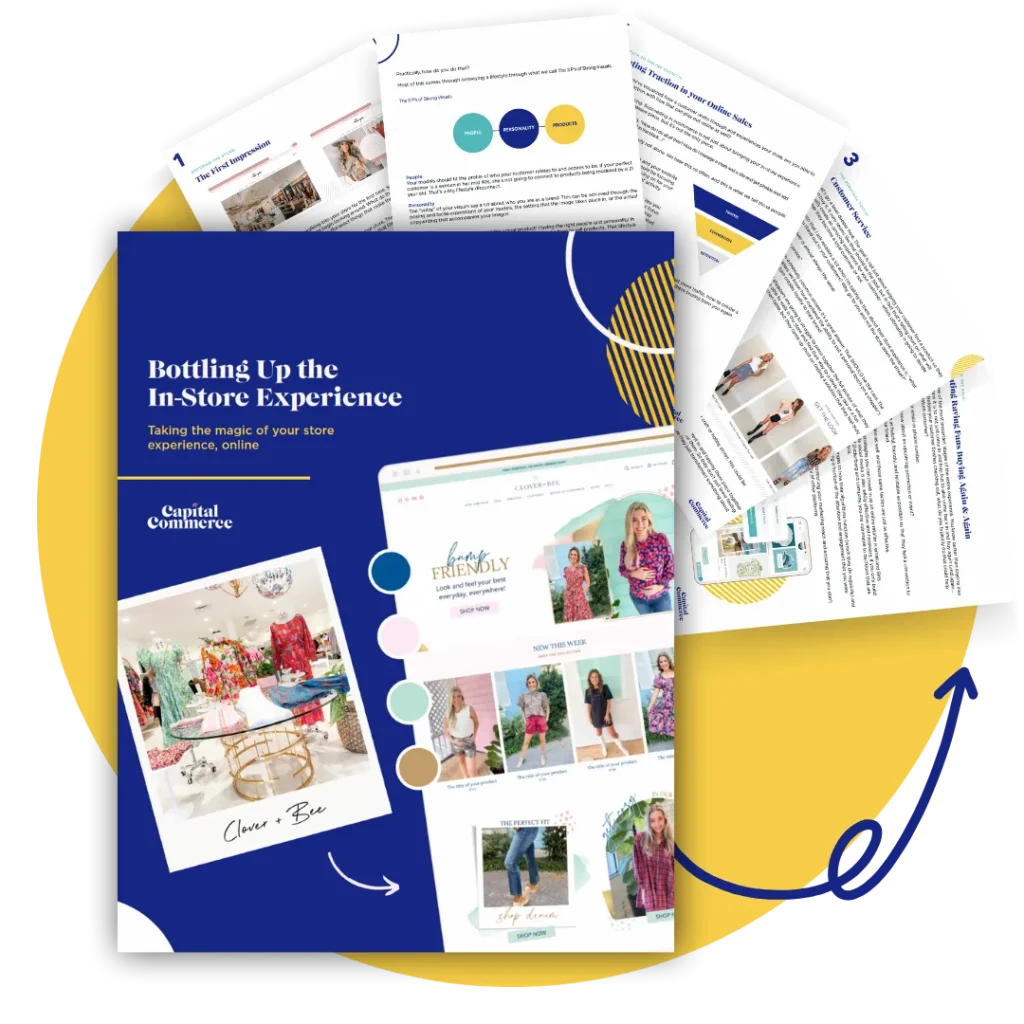
GRAB IT HERE

Your store works.
People walk in, stay longer than they planned, and leave with bags. You know your customer. You know how to merchandise. You know how to serve someone better than any algorithm on the planet.
Then they visit your Shopify site, and something falls flat.
It’s a version of your store, but thinner. Less feeling. Less personality. Less of the reason people drive across town to walk through your door in the first place.
Here’s the thing. Most of the advice out there about bringing your in-store experience online completely misses what makes your store great to begin with. So retailers chase the wrong fixes, spend a year frustrated, and end up convinced Shopify just doesn’t work the way a physical store does.
It can. You just have to translate the right things.
Let me walk you through how.
What Retailers Think Translating the In-Store Experience Means (And Why It Doesn’t Work)
Before we get to what actually works, it helps to name what doesn’t. If you’re doing one of these, stopping is step one.
Myth 1: Put a Picture of Your Store as the Hero Image
I see this a lot. A retailer says, “People love how my store looks,” so they throw a photo of the storefront on the homepage and hope that feeling translates.
It doesn’t.
You can’t experience a store by looking at a picture of it. Going to Disney World and coming back with a notebook of photos is not the same as going to Disney World. The photos are not the experience. The ride was.
If you want your customer to feel the way she feels when she walks in, that feeling has to come through in the vibe of the entire site, not in one storefront shot on the homepage.
Myth 2: Replace Your Salespeople With a Chatbot
Another one. A retailer is great at helping people in person and thinks, “Let me drop a chatbot on the site so customers can get the same thing.”
Almost nobody buys from chatbots.
People don’t land on a boutique website and start typing questions into a bot. They scroll. They scan. They form an impression in about five seconds, and that impression is what decides whether they stay.
Customer service online doesn’t look like a chat window.
It looks like answering the right questions before your customer has to ask.
Okay. Now the actual work.
The Three Things to Actually Translate From Your Store to Your Shopify Site
What makes a great store great is never one thing. When I break it down for the retailers we work with, it always comes back to three pieces:
→ Aesthetic
→ Service
→ Curation
Most retailers focus on one and skip the other two. That is why the site feels off even when parts of it are genuinely nice.
Here is how each one translates.
1. Aesthetic: Translate the Vibe, Not the Details
Most agencies that promise to “capture your in-store feel” will pick one visual detail from your store. A wallpaper pattern. A color from your wall. A fixture.
Then they paste that detail somewhere on the site and call it a day.
That is not translation. That is wallpaper theft.
Think about how Anthropologie does it. Their stores have a specific feeling. You walk in, and the scent, the lighting, the displays, the merchandising, all of it creates a mood.
Then you visit their website, and the imagery carries the same mood. Different photos, different layout, different season, but the vibe is unmistakable.
That is what translation actually looks like.
For your store, the question is not what physical detail can I paste online. The question is:
If I had to describe the vibe of my store in three sentences, what would I say?
Write it down. Then hand it to whoever is doing your photography, your graphics, and your email design, and say, “this is what I want people to feel when they land on the site.”
That is how the vibe lands. Through direction, not a wallpaper swatch.
2. Service: Translate the Questions You Ask, Not the Chat Window
When a customer walks into your store looking for a dress, you do not spin around and shove four dresses at her.
You ask a question.
“What is it for?”
“Is there a length you are comfortable with?”
“Are you looking for something easy or something more special?”
Those questions are what shape the answer you give her. That is service. That is how curation happens live.
Now look at your site.
Most boutique Shopify sites are a catalog. A grid of dresses with filters for size and color. The customer is expected to do all the work that your salesperson would have done for free.
So translate the questions into structure.
Your navigation should not just be categories. It should be the paths your actual customer takes.
For dresses, that might be:
→ By occasion
→ By length
→ By style
For denim, it might be:
→ By fit
→ By wash
→ By brand
Those are real ways real customers narrow down what they want. When you organize the site around the questions, the site starts serving her the way you would in person.
The other place service shows up is on the product page. If you are great at in-store styling, that should show online too. A shop the look feature on product photos, outfit suggestions, a “styled with” section, all of that is you translating the styling conversation into a scroll.
You are not hoping she figures it out. You are answering the question she was about to ask.
3. Curation: Translate Who You Serve, Not What You Stock
This is the piece most retailers miss, and it is the most important one.
In your town, your competitive advantage might be “I am the only store that carries that brand.”
Online, that goes away immediately.
The moment a customer opens a browser, your exclusivity evaporates. She can get that brand from 40 places. She can price-compare you in 12 seconds. Being the only one in town stops meaning anything once you cross into the internet.
So what is left?
Your taste. Your point of view. The fact that you know exactly who you serve and you have pulled together a collection specifically for her.
When your perfect customer lands on your site, the feeling she should walk away with is:
“Oh my gosh. This brand gets me. I would have to visit 15 stores to find this combination of things. They already did that work for me.”
That is the superpower. Access is weak. Understanding is durable.
Curation online is bigger than your product mix. It shows up in your homepage sections, your collection names, your lookbooks, your email segmentation, your ad creative, and your blog content. Every touchpoint should be saying we made this for you, and we know who you are.
That is what keeps her from bouncing to Amazon the moment she sees a lower price.
What It Looks Like When All Three Land
Vibe. Service. Curation.
When a site has all three, something clicks. The customer does not consciously think, “wow, the aesthetic is consistent with the brand voice, the navigation is built around my actual decision tree, and the curation reflects a deep understanding of my life.” She just feels at home. She stays. She buys.
When a site has one or two of the three, it feels like a nice website that still does not convert the way the store does. Familiar story.
Once all three are in place, your online channel starts to behave like a second location. An actual revenue engine that reflects what you are already doing well in person.
That is what we build with the retailers we work with.
Ready to Translate Your In-Store Experience to a Shopify Site That Performs?
If you are doing $500K or more in-store annually, you have a proven brand and a loyal customer base, and your website is the piece of the business that is not keeping up, this is exactly the kind of problem we solve.
Our flagship program, Momentum, takes established retailers through a 12-week process to translate the store to a custom Shopify site, set up Klaviyo properly, and train your team on how to actually run the ecommerce side of the business. The outcome is a website that feels like your store and performs like a second location.
If that sounds like where you are trying to take things, book a strategy session below. We will look at your business together, see whether Momentum is a fit, and if it is not, point you toward what actually is.
Capital Commerce works exclusively with established independent retailers. If you own a boutique, home store, or specialty shop doing at least $500K annually in-store and you want your online presence to match what you have built in person, we should talk.